The World’s Most Recognizable Ringtone Started as a Classical Guitar Piece

Hello Friends,
Here’s one of those music history facts that still catches people off guard.
The melody most people instantly recognize as the Nokia Tune actually comes from a classical guitar composition written in 1902.
Long before it became the sound of incoming calls around the world, it was part of Gran Vals, a piece composed by Spanish guitarist and composer Francisco Tárrega. What eventually became one of the most recognizable melodies in modern technology started as a short phrase inside a classical waltz written for solo guitar.
It’s a great reminder that music has a way of traveling through time in ways nobody can predict.
The Original Composer Behind the Nokia Tune
Francisco Tárrega is one of the most important figures in classical guitar history.
He played a huge role in shaping modern classical guitar technique and helped establish the guitar as a respected concert instrument. His compositions are still studied and performed today because of their technical detail and expressive phrasing.
Gran Vals was written as a formal concert piece, built around the kind of melodic elegance and harmonic movement that defined much of Tárrega’s work.
The now-famous Nokia phrase is just a small section of the larger composition.
When Tárrega wrote it, there was obviously no way he could have imagined that a few notes from his piece would one day be heard billions of times through mobile phones.
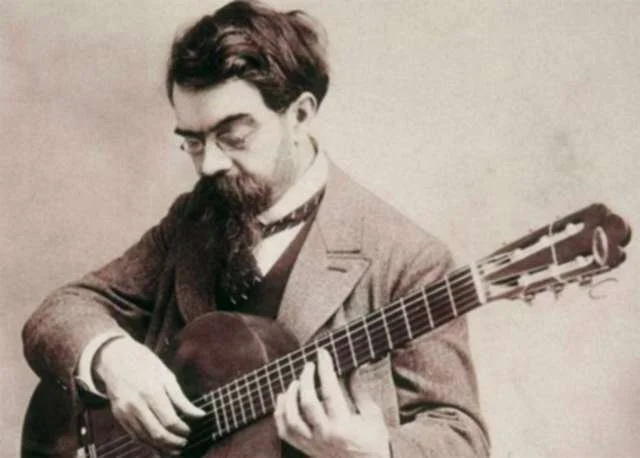
Photo Credit: Picryl
How It Became a Global Sound
Nokia introduced the ringtone in the 1990s, using a short excerpt from Gran Vals as part of its mobile branding.
At the time, mobile phones were becoming part of daily life, and that melody quickly became attached to the experience.
What’s interesting is how this happened.
It didn’t become famous through radio.
It wasn’t tied to a hit record.
It didn’t come through film or TV placement.
It became recognizable through repetition.
For years, it played everywhere, in offices, restaurants, trains, classrooms, and just about every public space you can think of.
By sheer exposure, it became one of the most widely heard pieces of music in modern history.
Hearing It the Way It Was Originally Intended
That’s what makes performances like George Sakellariou’s so interesting.
In this performance filmed in Santa Monica, he plays Gran Vals as it was originally written, giving people the chance to hear the full composition rather than just the familiar ringtone fragment.
Sakellariou studied under Andrés Segovia, one of the most influential classical guitarists of the 20th century, and brings a deep understanding of the piece’s phrasing and structure.
When heard in full, the melody takes on a completely different meaning.
What most people associate with a quick phone alert becomes part of a much larger musical conversation, filled with movement, dynamic contrast, and subtle harmonic shifts.
It’s a completely different listening experience.
The Guitar Adds Another Layer of History
There’s another detail here that makes this performance even more fascinating.
Sakellariou performs it on an 1862 guitar built by Antonio de Torres.
Torres is widely considered one of the most influential guitar makers in history. His designs helped shape what we now recognize as the modern classical guitar.
So you have this interesting intersection of timelines.
A melody written in 1902.
Played on an instrument built in 1862.
Later repurposed as the defining sound of late 20th-century mobile technology.
That’s a pretty incredible journey for a few notes.
What This Says About Music
I think this story says something important about how music works.
You never really know where a piece will end up.
A composition written for intimate classical performance can eventually become part of global culture in a completely different form.
It’s one of the things I love most about music history.
Sometimes the smallest phrase, tucked inside a much larger work, ends up becoming the part the world remembers most.
And in this case, one of the most recognizable sounds ever created started as a beautifully written classical guitar passage.
Pretty wild when you think about it.
-Nathan
Share this article
Let’s Create Together
Are you a visual storyteller in media? My team and I are excited to explore how we can bring your stories to life with distinctive soundscapes. Get in touch and let’s discuss how music and sound design can transform your project.
++

++
Nathan's Picks


++